
Last week, we had the pleasure of hosting Dr Sara Simblett, Clinical Psychologist and CEO of The London Neurocognitive Clinic, for another instalment in the NeuroHealth External Speaker Webinar series. Sara, also an academic at King’s College London, presented on “Executive Functions: From Theory to Clinical Practice”.
Sara provided an insightful overview of executive functions, also known as higher-level cognitive functions or prefrontal functions; they involve coordinating and controlling multiple cognitive processes over time to achieve goals.
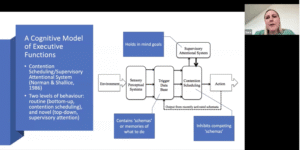
Sara explained a cognitive model of executive function, detailing how different mental processes work together and the internal and external factors that influence their effectiveness. She emphasised the role of schemas (memories) in triggering responses and how having a bank of memories helps individuals adapt to situations.
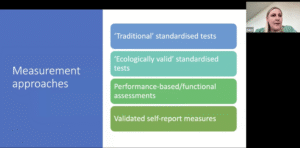
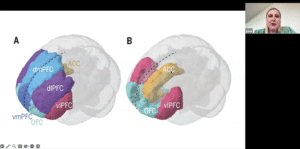
We also discussed the impact of traumatic brain injuries on the frontal lobe, the brain’s control centre for higher-order thinking, and how this leads to executive dysfunction. The ‘frontal lobe paradox’ was another key topic, illustrating how individuals with frontal lobe injuries can perform well in structured tests but struggle with everyday tasks. Sara outlined various methods for measuring executive functions, including traditional standardised tests, performance-based assessments, and validated self-report measures. The webinar culminated in a case study review, taking into consideration how executive dysfunction can present in a variety of ways in an individual who has sustained a traumatic brain injury.
A huge thank you, Sara, for a very informative presentation that deepened our understanding of executive dysfunction and emphasised the importance of viewing executive functions within the context of a holistic neuropsychological framework, recognising their interactions with other cognitive processes and their relevance to clinical practice.