
After a short summer break, we were delighted to welcome three brilliant speakers from Brainkind for the latest in our NeuroHealth External Speaker Webinar Series.
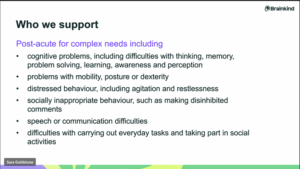
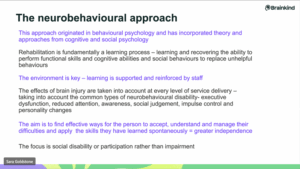
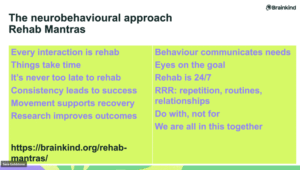
Sara Goldstone (Clinical Lead Occupational Therapist), Jenny Woodgate (Clinical Lead Physiotherapist), and Dr Sara da Silva Ramos, CPsychol (Senior Research Fellow and Chartered Psychologist) shared insights into Brainkind’s neurobehavioural approach to rehabilitation and the services they offer.
What began as a father’s vision in the 1980s has grown into Brainkind (formerly The Disabilities Trust and BIRT), a nationwide charity supporting individuals with brain injuries. Their services span hospitals, neurobehavioural centres, and supported living, with all profits reinvested into life-changing rehabilitation.
Brainkind’s rehabilitation pathway includes:
– Restoration: Early rehab in hospitals and neuro centres.
– Compensation: Support in adapting to impairments in the post-acute stage.
– Support/Scaffolding: Long-term care and independence in supported living.
The team explained how rehabilitation is a learning process – developing habits through structured, real-life practice. At centres like Kerwin Court, clients engage in everyday activities such as cooking, laundry, gardening, and community outings in realistic environments. The MDT plays a central role in delivering Brainkind’s neurobehavioural rehabilitation model. The team includes Physiotherapists, Occupational Therapists, Speech and Language Therapists, Neuropsychologists, and Rehabilitation Support Workers, all working collaboratively to design and implement individualised rehabilitation plans and ensuring therapy is not just limited to scheduled sessions but is incorporated into daily life. Kerwin Court offers en-suite bedrooms, self-contained flats, and bungalows that allow clients to transition toward independence. Innovative technology is also utilised to support the tracking of progress and provides valuable insights that influence therapeutic input.
Dr Da Silva Ramos shared how Brainkind uses outcome measures like the Mayo-Portland Adaptability Inventory and Supervision Rating Scale to track real-world progress in independence, participation, and emotional adjustment after brain injury, as well as Brainkind’s Independent Living Scales which it has developed from the Community Disposition Ratings scale (by Eames & Wood) and looks at accommodation and occupation, and helps the MDT to track how clients transition toward independence and meaningful activity during and after rehabilitation.
A huge thank you to Sara, Jenny and Sara for providing an insightful session into the great work that Brainkind do and how their neurobehavioural approach and integrated rehabilitation services empower individuals with brain injuries to rebuild independence through structured, real-life learning.