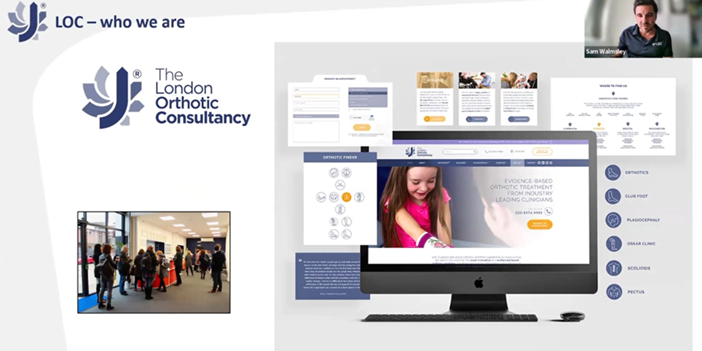
After a brief summer break, the NeuroHealth External Speaker Webinar series returned in September, and we were very fortunate to have Sam Walmsley, Director & Senior Orthotist, of The London Orthotic Consultancy (LOC) share his expertise with the team.
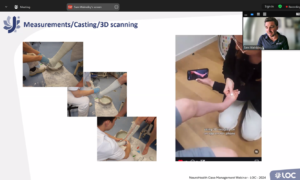
LOC, with clinics across the UK, manufactures bespoke orthotic treatments for a wide range of adult and paediatric conditions. They are immensely passionate about how orthotics can change and improve lives and have researched and introduced several new treatments and innovative orthotic solutions to the UK. Sam, with over 20 years of experience working in orthotics, spoke about the fascinating recent changes and advances of technology in this area, a far step (or gallop!) from the time of Eadweard Muybridge, the father of gait analysis, in the 1870s and casting in plaster of Paris!
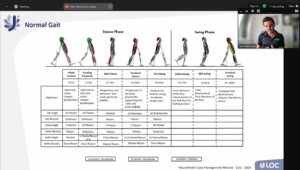
Sam explained more about understanding normal gait; swing and stance phases, where forces are normal musculature, articulations (hip, knee and ankle) and movement, and neurology.
The above was looked at with pathological gait and how this enables an orthotist to understand where the instability and weakness is, whilst considering pain, so that they can then look to resolve the issue with orthotics and, essentially, take people, especially children, out of pain both now and potentially in the future. Sam noted that, in total, 58 decisions are required per orthotic!
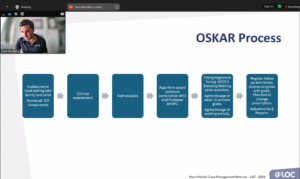
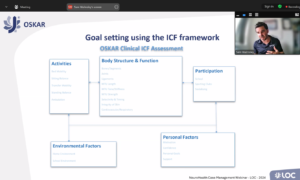
Orthotics are a treatment via a process and Sam explained about OSKAR –Optimal Segmental Kinematics and Alignment Approach to Rehabilitation – a treatment, typically used with children with lower limb neurological conditions caused by such conditions as cerebral palsy, which offers a very holistic package. Considering goals, and thinking carefully about where the individual will wear the orthoses and how they will put it on and take it off, allowing for fine-tuning and adjustments, OSKAR gives back function and reduces the need for short-term measures such as surgery and botox.
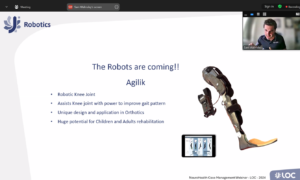
We briefly looked at another new technology being introduced by LOC – Agilik, a robotic knee joint. This is attached to an orthotic and initiates power through the knee joint thereby stabilising the knee and stance. Excitingly, although this equipment is expensive, a test kit is available, whereby it can be trialled, making it possible for decisions on funding for further use to be based on definitive results, not recommendations alone.
A huge thank you, Sam, for an engaging and informative talk on a rapidly advancing area of rehabilitation that is crucial to empowering both children and adults through improved mobility, and with so many ongoing developments and changes in orthotics we do hope you will be back to provide us with more updates!